
Let’s Talk About Books
a conversation with
James Kirby
23rd August 2024

I’d like to give a warm welcome to
debut writer, James Kirby.
James’ short story collection
Waiting at the Door
will be published by Vanguard Press on 29th August 2024.
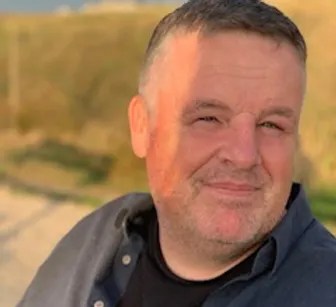
It’s really good to have you here, James. Can you tell me a little bit about yourself and how long you’ve been writing?
Hi Callie, thank you for having me. Writing is a fairly recent thing for me. I’m a mechanical engineer by profession, mostly for the water industry. Like a lot of people, I’ve always wanted to write but it wasn’t until lockdown that I had the time and space. And then one thing led to another and I decided to do an MA in Creative Writing at the University of Hull.
I’ve heard good things about the MA at Hull. I’d love to hear more about what it entails.
The MA was a turning point. It was so much fun. I could forget that I was dyslexic. I hated English at school, so to have the freedom to write was great. As a taught MA, the modules were The Writers Craft, Writing the Short Story, Writing the Novel and Writing from Life. It was extremely well-organised but with freedom to write whatever I wished. I wrote about the Cotswolds, the Lake District, and Australia. The old, the infirm, the young, and the disadvantaged. In the academic commentaries, which were only weighted at 20%, I was able to discuss the merits of what I was reading at the time, Laurie Lee, Susan Hill, novels such as Birdsong, as well as reference to craft books such as First You Write a Sentence and Bird by Bird.
It’s no wonder your writing is so exquisite. You seem to have mastered the perfect blend of aesthetic prose while incorporating engaging plots with a twist in the tale. It must be really exciting to see your fantastic stories in print. Did you write them as part of the MA?
I had started a lot before the MA but the book was already going through the editing process. In fact, I pasted in a lot of work that had been marked as late amendments.
50% of what I wrote for the MA was historical fiction from my novel set in WWII – although some of the characters in my short stories are also in the novel. I’m currently honing this and hope to publish in the not-too-distant future.
That will definitely be one to look out for! Do you have a working title?
I’m currently working on fiction that I have initially called Little Mouse. This is the codename given to a Belgian woman who helps escaped POWs in 1942 France and formed what I submitted for my dissertation. When this has been marked, I will be able to finish it.
I love the metaphorical title of ‘Waiting at the Door’, and the short story of the same name is my absolute favourite in the collection. It has everything I love in a story with great characters that really delve into family dynamics. Although the central character is a young boy, the first-person narrative voice is so authentic, as a reader you can’t help but be pulled right into his thoughts and feelings. I loved the twist at the end – but not only that, the extra twist was just heartbreaking.
Do you have a favourite story in the collection? And why?
Slug. I included this story in the appendices. It’s essentially a children’s story that I wrote during my MA when asked to explore point of view. For example, options included inanimate objects such as a watch or a pen. I chose to write about a horse in first person. No names were changed so I guess it’s a true story.
In some ways, writing short stories can be harder than writing a novel as you have to think up lots of different stories. What is the most difficult part of writing for you? The actual writing process or thinking up ideas? Is there an aspect that you like the most.
My starting point is usually a truth of some sort, a character or a setting. And plot can develop as you write. To date, writing has been easy for me. It’s good writing that is difficult. Finding your voice, the pace, editing in imagery; and the final stress, making each sentence finish strong. Cutting is important too, so that a sentence is ‘pared back’ as they say.
I like doing the research for a story. Particularly for my historical fiction novel. My father was a commando during the war, so a lot of the storyline has come from his personal experience, but there has also been a lot of research outside of that.
What kind of literary research do you do, and have you ever been on any research vacations?
I consider reading in general a type of research, so I’ve tried to read from varied sources because I’m interested in the voice. For instance, Du Maurier is outstanding, I think and not something that I would normally have read. In terms of specific research, I have a large collection of military history, mostly the second world war era. Specifically, the history of the early commandos. However, my favourites are First Light by Geoffrey Wellum, and Nancy Wake by Russell Braddon. She named her dogs after a drink, Amer and Picon – how cool is that!
I have visited the memorials at Spean Bridge and the St. Nazaire memorial at Falmouth, and I would like to visit St. Nazaire, France.
It sounds like you do a lot of reading, James. Is there any particular author that inspires you?
There are two aspects that I admire. The story and then the language – the voice, cadence or rhythm. In terms of story, I’m inspired by works such as The Small Hand by Susan Hill and Horns by Joe Hill. In terms of story these blew my mind. In terms of prose then it’s Laurie Lee. As I walked out one Midsomer Morning was a game changer for me.
Well, it’s been lovely talking to you today. I could listen to you talking about books all day. I can’t wait to see your historical novel in print. It would be amazing if you could come back and talk to me about it when it’s ready for publication.
Thank you, Callie. I look forward to chatting with you again soon.
Waiting at the Door will be published by Vanguard Press on 29th August 2024.

Waiting at the door and other stories: Amazon.co.uk: Kirby, James: 9781800166974: Books

 Literature Love Ltd
Leave a reply to Suzanne Cancel reply